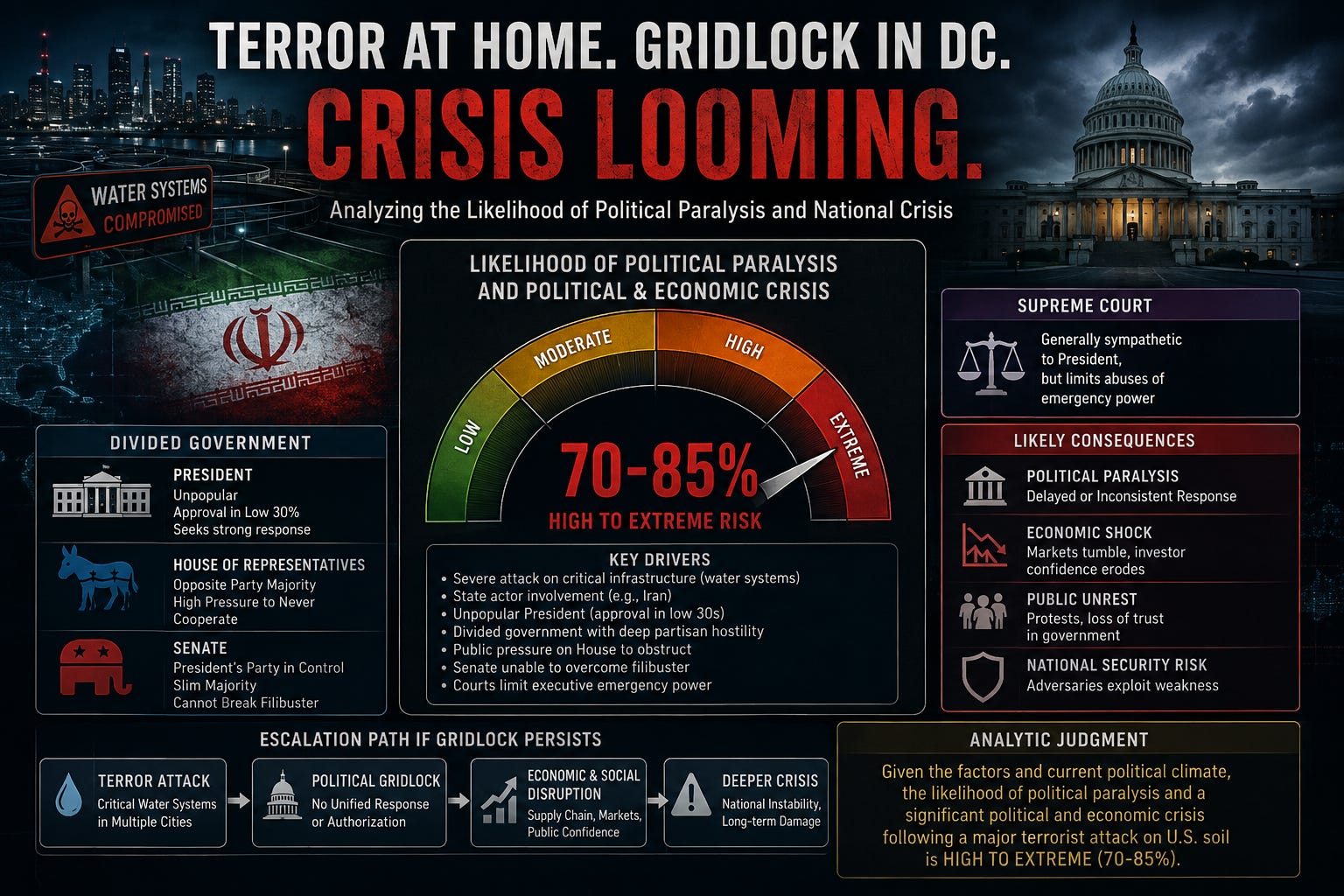
Why LAMP Is Critically Important In This Political Moment.
News of Iran's attempt to attack our water supply infrastructure could create

For some time now, I’ve been sketching out what I hope is a framework that elected officials and political activists, especially Christians, can use to change our political system for the better. I use the acronym LAMP - love, accountability, meekness, and purpose - to describe this framework. I’ve received much positive feedback from readers, so I’ll continue writing in this vein for a while.
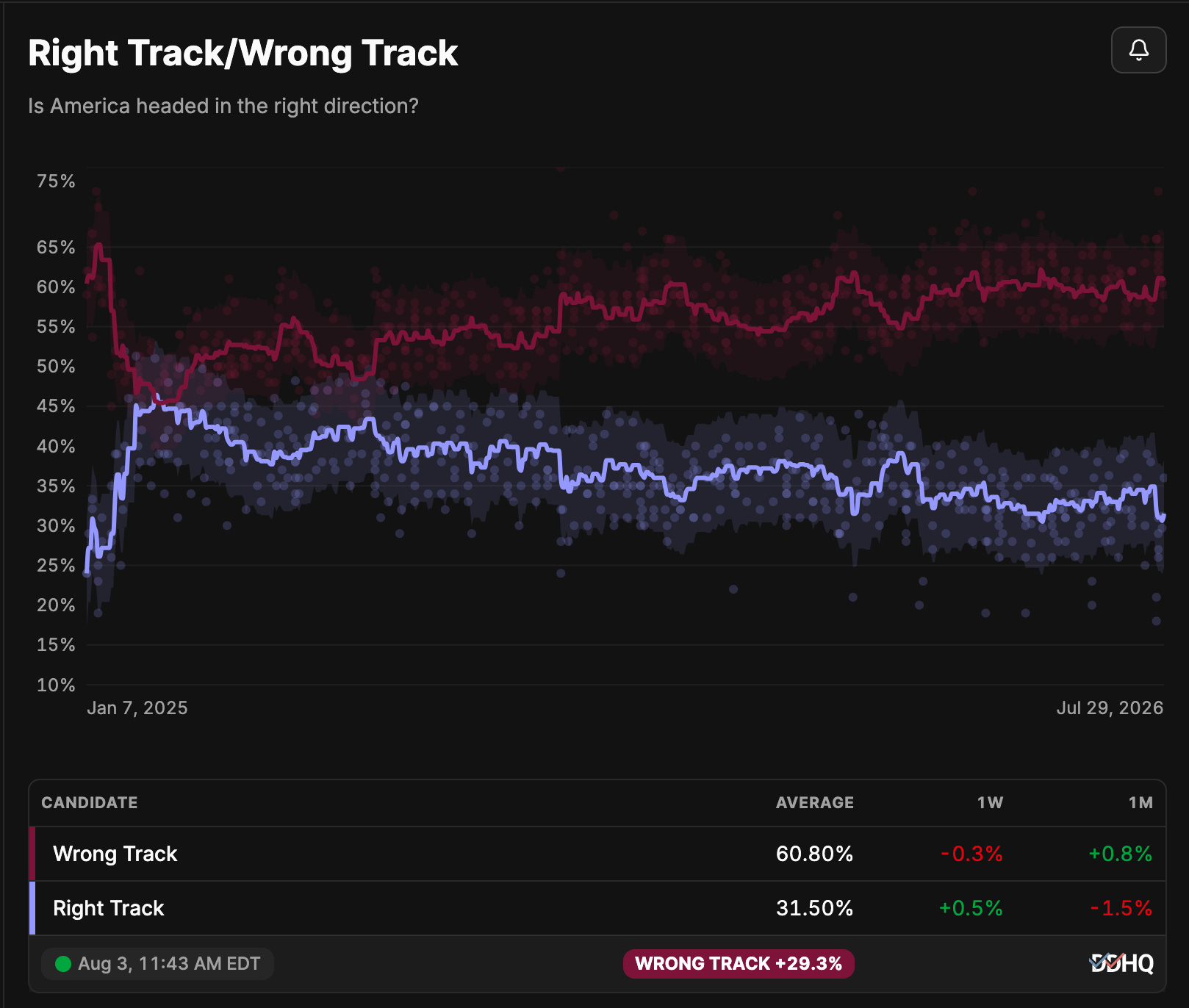
Many people I know are unhappy with the present state of affairs. Public polling confirms they are not outliers, as seen in this chart from Decision Desk HQ. A super-majority of Americans think we are headed in the wrong direction.
This November, millions of Americans will head to the polls to vote for (or against) politicians at the Federal, State, and Local levels. Control of Congress is up for grabs, and many experts think Democrats are poised for a big win. The predicted scenario headed into the new year is that Democrats will control the U.S. House, while Republicans will control the U.S. Senate. President Trump, of course, will still be in the White House no matter the outcome on November 3rd.
Late last week, reports surfaced that Iran was the likely source of cyber attacks on municipal water systems across the country, including some in Georgia. This is a rather frightening escalation in the battle with Iran.
I link those two things together to make an important point: the character of the people we elected to Congress this fall is more important than which political party they belong to. We all vote for candidates we feel will best represent our values, but I think it’s critically important at this time in American history to think very carefully about how those elected officials will behave in times of crisis, because we just might get one.
What follows is an Intelligence Assessment I generated using Gemini Flash 3.6. Here is the prompt I used, asking Gemini to predict, using the ICD 203 Analytic Standards and the RAND Report R-3235 Escalation Ladder.
“Using the attached sources, analyze the probability of a major political crisis following a terrorist attack within the borders of the U.S., assuming political gridlock prevents Congress and the President from agreeing on an appropriate response. Let’s assume the terrorist attack is on critical infrastructure such as the water systems in several large cities. The attack is carried out by a state actor such as Iran. The President is unpopular, with approval ratings in the low 30s; Congress is led by the Party opposite the President, and many members of the House feel public pressure to never cooperate with the President. The Senate is led by the President’s party, but the majority is slim, not enough to break a filibuster. The Supreme Court is mostly friendly to the President, but in key cases, is willing to rule against what they see as abuses of emergency power provisions of the law. What is the likelihood of political paralysis and a political and economic crisis?”
It paints a grim picture of how a potential post 2026 election political landscape might deal with a successful Iranian attack on our water system.
I pray this situation never arises. I pray that if such a situation did arise, our elected leaders would set aside partisanship and rise to the occasion. I pray that Christians on both sides of the aisle would let love, accountability, meekness, and purpose inform their response to such a crisis.
INTELLIGENCE ASSESSMENT
SUBJECT: Probability Assessment of Political Paralysis and Institutional Crisis Following State-Sponsored Attack on U.S. Critical Infrastructure
ANALYTIC FRAMEWORK: Intelligence Community Directive (ICD) 203 Analytic Standards & RAND Report R-3235 Institutional Escalation Dynamics
Scope Note & Context
This assessment evaluates the likelihood of severe political paralysis and a concurrent political and economic crisis following a terrorist attack on U.S. municipal water infrastructure attributed to a foreign state actor (Iran). The analysis evaluates structural variables including an unpopular President (approval rating in the low 30s), a divided Congress (an opposition-led House under strong anti-cooperation pressure and a Senate held by a slim presidential majority unable to overcome a filibuster), and a Supreme Court willing to limit executive emergency authorities.
Degrees of likelihood used in this product comply with ICD 203 standardized probabilistic language:
Almost Certain / Nearly Certain: 95–99%
Very Likely / Highly Probable: 80–95%
Likely / Probable: 55–80%
Roughly Even Chance / Odds: 45–55%
Unlikely / Improbable: 20–45%
Very Unlikely / Highly Improbable: 05–20%
Almost No Chance / Remote: 01–05%
Key Judgments
Primary Judgment: Under the specified conditions, it is Almost Certain / Nearly Certain (95–99%) that the United States will experience both severe political paralysis and a major systemic political and economic crisis.
Impact of Critical Infrastructure (Water Systems): Targeting municipal water systems in multiple major cities compresses operational response timelines from months to hours, creating immediate public panic, severe commercial disruptions, and acute municipal emergency costs. This deprives political leaders of the time needed to negotiate legislative compromises.
State-Actor Attribution (Iran) Escalation: Attribution to a foreign state actor introduces international conflict dynamics. Rather than creating a unifying “rally-around-the-flag” effect, deep political polarization will turn attribution into a partisan battlefield regarding intelligence failure, foreign policy provocation, and War Powers Act limitations.
Unilateral Executive Overreach & Constitutional Clash: Denied legislative action by an uncooperative House and a filibustered Senate, a weak President (low 30s approval) will rely on unilateral Executive Orders and emergency declarations to deploy military assets, federalize infrastructure, and reallocate funds. With a Supreme Court willing to enforce constitutional limits on executive power, judicial injunctions against the President will trigger a full-scale constitutional crisis.
Analytic Decomposition of Impact Factors
1. Target Selection: Municipal Water Systems & Economic Shock
High Operational Impact: Disruption or contamination of municipal water supplies in several large cities directly threatens human survival, urban sanitation, hospital operations, and commercial manufacturing.
Instantaneous Economic Paralysis: Affected metropolitan areas will experience immediate commercial shutdowns, supply chain freezes, panic buying, and steep drops in municipal bond ratings.
Loss of Negotiation Runway: Unlike financial or digital cyberattacks where emergency liquidity can buffer immediate damage, water infrastructure failures demand physical logistics (e.g., National Guard water transport, municipal boiling orders, industrial shutdowns). This eliminates the decision time required for legislative negotiation.
2. Actor Attribution: State Actor (Iran) vs. Domestic Polarization
War Powers and Geopolitical Framing: Attribution to Iran elevates the crisis from a domestic law enforcement emergency to an act of foreign aggression.
Inversion of the “Rally Effect”: Deep polarization and an unpopular President (~30% approval) negate the historical “rally-around-the-flag” phenomenon.
The opposition-led House will frame the attack as evidence of the administration’s foreign policy failure or deterrence collapse, launching Congressional investigations rather than passing emergency aid.
The President will frame opposition resistance as national security obstructionism, using the threat from Iran to justify unilateral military actions or domestic emergency measures.
3. Legislative Dynamics: Structural Statutory Lock
House Zero-Compromise Pressure: Opposition House members facing intense constituent pressure to avoid cooperating with an unpopular President will refuse to pass administration-sponsored emergency aid, federal grants, or statutory authorizations.
Senate Filibuster Barrier: Although the President’s party holds a slim Senate majority, it lacks the 60 votes required to break filibusters, guaranteeing that legislative packages proposed by the White House will stall.
Statutory Paralysis: The probability of Congress passing unified emergency recovery legislation or foreign policy authorizations under these constraints is Almost No Chance / Remote (01–05%).
4. Executive-Judicial Dynamics: Constitutional Confrontation
Unilateral Executive Action: Facing statutory gridlock, an isolated President will attempt to govern by decree—invoking emergency authorities (e.g., Defense Production Act, Insurrection Act, or reallocating federal funds).
Judicial Intervention: Opposition House leaders and affected state governors will file immediate lawsuits. Because the Supreme Court is willing to rule against executive emergency overreach, high-profile injunctions halting presidential orders are Likely / Probable (55–80%).
Constitutional Crisis: If the President ignores judicial stays citing “national security necessity” or commander-in-chief powers during an active state-sponsored infrastructure emergency, institutional checks and balances break down completely.
Institutional Escalation Dynamics (RAND R-3235 Framework)
Applying the RAND R-3235 escalation model demonstrates how operational shocks cross critical thresholds into institutional paralysis:
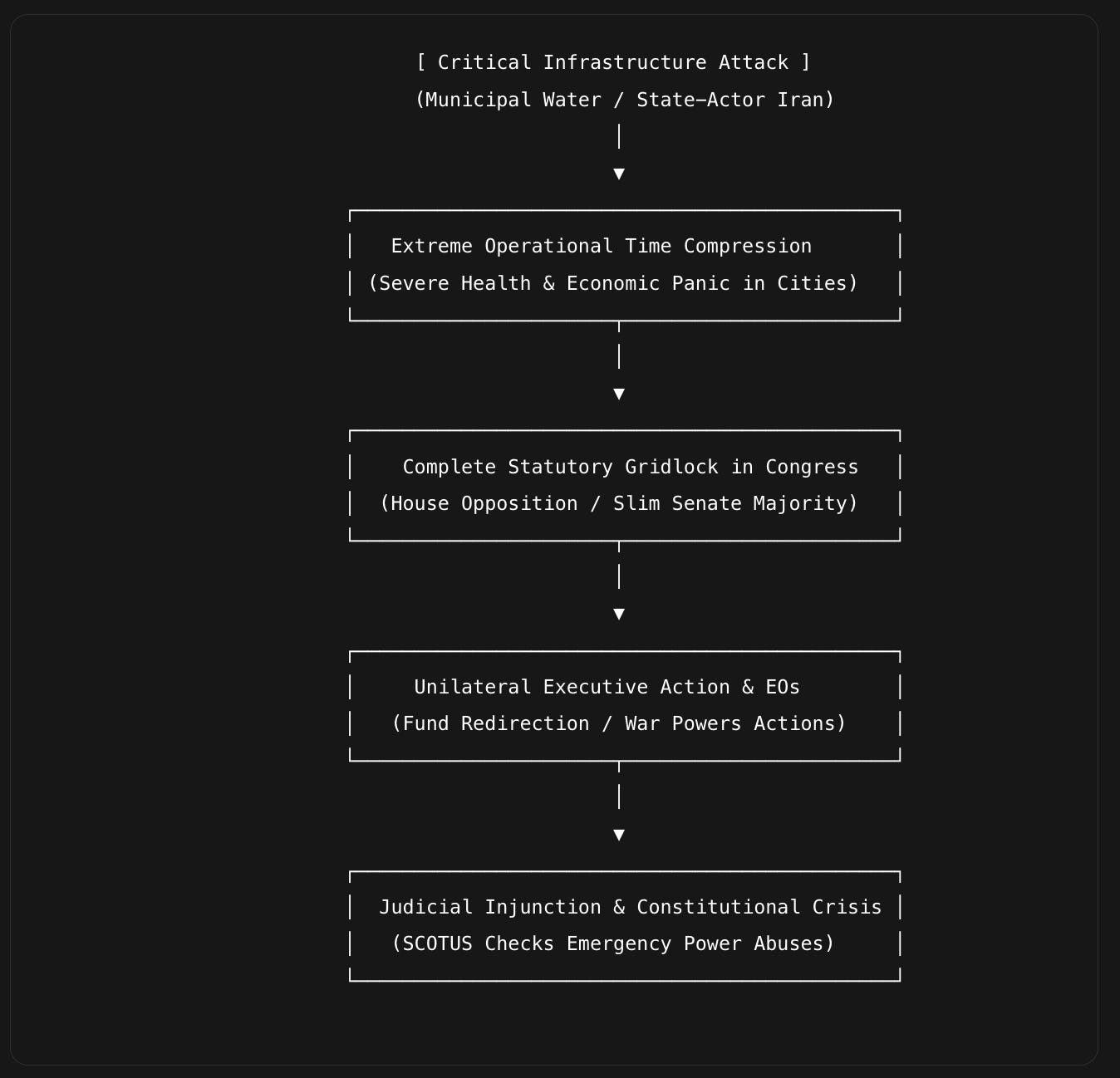
Threshold 1 (Operational Shock → Domestic Mobilization): Municipal water infrastructure failure in major cities forces state governors and the executive branch into immediate crisis response.
Threshold 2 (Domestic Shock → Statutory Lock): The House opposition refuses bipartisan cooperation, while the Senate is locked by filibuster. Statutory mechanisms fail to provide funds or legal frameworks.
Threshold 3 (Statutory Lock → Unilateral Executive Overreach): The President uses executive orders to commandeer resources or launch military actions against Iranian targets without congressional authorization.
Threshold 4 (Executive Overreach → Constitutional Breakdown): Judicial injunctions against executive emergency overreach create an institutional standoff between the White House, Congress, and the Judiciary, converting an external security attack into an internal regime crisis.
Analysis of Alternatives (Alternative Scenarios)
Alternative Scenarios and Their Probability
Bipartisan Emergency Consensus: Very Unlikely / Highly Improbable (05–20%) House opposition leadership breaks party discipline due to extreme public pressure in affected urban districts; temporary narrow crisis funding passes.
Judicial Deference to Executive: Unlikely / Improbable (20–45%) Supreme Court invokes the “political question doctrine” or grants temporary emergency latitude to the President regarding state-actor retaliatory measures.
Full Institutional Collapse & Systemic Crisis: (Primary)Almost Certain / Nearly Certain (95–99%) Acute municipal water failure, zero-compromise House gridlock, unilateral Executive Orders, and SCOTUS emergency power injunctions converge simultaneously.
Probability Matrix Summary
Likelihood of Statutory Paralysis in Congress: Almost Certain / Nearly Certain (95–99%)
Likelihood of Unilateral Executive Actions: Almost Certain / Nearly Certain (95–99%)
Likelihood of Major Domestic Economic Panic: Almost Certain / Nearly Certain (95–99%)
Likelihood of Supreme Court Injunction Against President: Likely / Probable (55–80%)
Likelihood of Overall Political and Economic Crisis: Almost Certain / Nearly Certain (95–99%)
Intelligence Confidence & Information Gaps
Analytic Confidence: High Confidence. The convergence of physical infrastructure damage, zero-compromise partisan incentives, low executive capital, and active judicial checks predictably leads to system paralysis.
Key Information Gaps:
Physical vs. Cyber Attack Mechanics: Whether the Iranian attack involves biological/chemical contamination of water reservoirs or SCADA/cyber-physical destruction of pump stations affects the duration of the water outage.
Duration of Municipal Outage: An outage lasting several days manageable via National Guard distribution generates moderate crisis; an outage extending across weeks produces widespread economic dislocation.
Scope of Retaliatory Military Action: The extent to which the President executes unilateral kinetic strikes against Iranian assets without congressional consultation.